
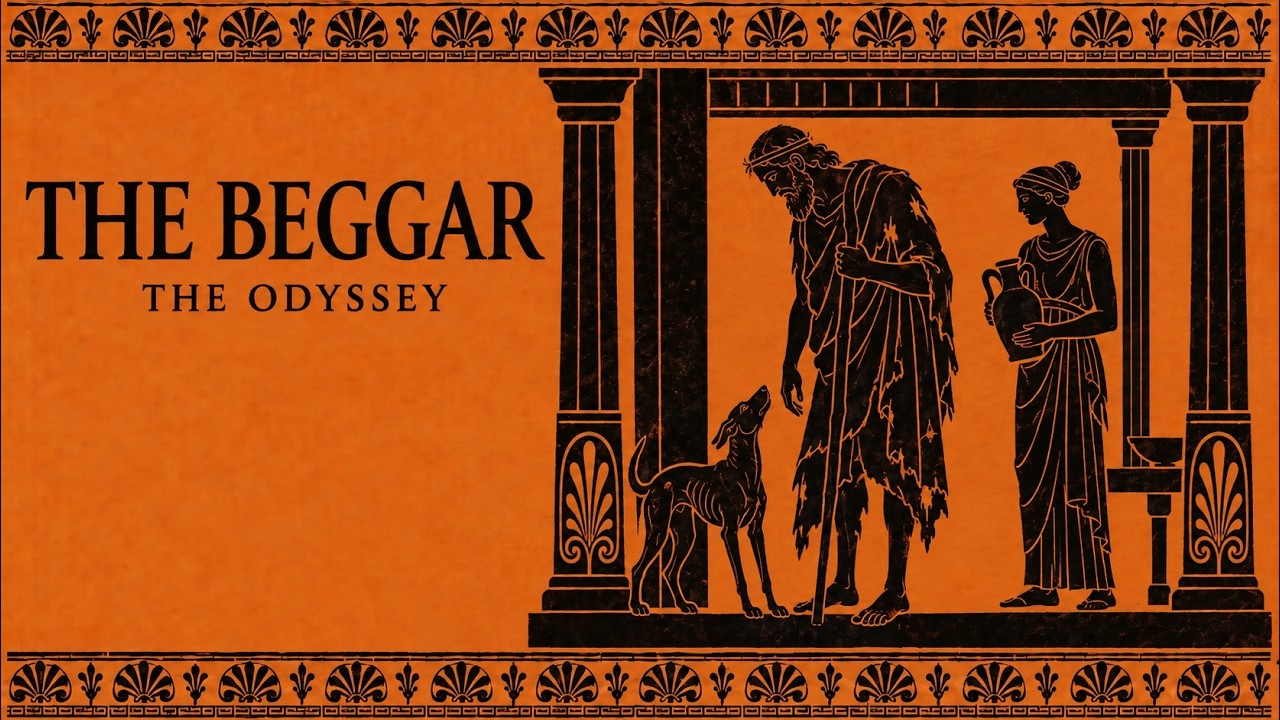
Welcome and the Singer at the Fire
Welcome to The Sleeping Almanac. Tonight, a king comes home to his own house, and not one soul inside it knows his face. He crosses his own threshold as a beggar in borrowed rags, begging scraps at his own tables from the men who have spent twenty years eating his house down toward the stones. You have likely never been told it slowly, the small true things the old song keeps. An old dog on a warm heap by the gate, who has outwaited every living thing on the island.
A queen coming down her own stair to rob the men who came to rob her. Two of the cleverest people the world ever made, knee to knee at a night fire, and one does not know the other. An old woman washing a stranger's tired feet, finding a scar she has known since he was a boy. Stay with it if you can. Nothing tonight is put right by force.
It is the long patience before all of that, and one of the tenderest nights on the whole road home. There is a beach at the edge of the world, and on it there is a fire. It is the same fire. Perhaps you have sat at it before, and if so, your place in the sand is where you left it. And if this is your first night, be welcome too, for the singer never begins a story that leaves a newcomer behind.
All you need will come to you as you go. The fire is low, built of driftwood the sea gave back, burning the pale gold of old honey. Beyond it the water is dark, the deep wine dark of the sea at night, breathing against the sand, asking nothing of you. By the fire sits the old blind singer, his worn hands open on his knees. Last night, he says, the man came home at last, though the island did not yet know it.
He met the grey eyed goddess under an old olive, climbed to a poor farm on the high ground, and in a swineherd's hut in the rain took his grown son in his arms and told him, after twenty years, that he was his father. Tonight he goes down into the town. You do not have to do anything now. Settle into the sand. Let the fire warm one side of you and the cool night the other.
Close your eyes if they want to close. You need not follow every word, or keep any of it until morning. If you drift, the singer goes on without you, and drifting is only another way of listening. And here is the fire's promise for tonight, and it will be kept. A king will be mocked on the road and struck in his own hall, and he will stand and take it and give no answer, because his hour has not come, and the fire will tell you plainly what he bears and never make a show of it.
Nothing is set right by force tonight. That morning belongs to another night. And there is an old dog whose ending is the gentlest there is, a long waiting finally allowed to rest. Nothing here will startle you. The night ends in a dark house full of sleep.
Before the singer begins, one small thing, and then we will not interrupt again. If this fire is a place you would like to come back to, subscribe now, while your eyes are still open, and the next night will be waiting for you when you need it. A like helps other tired travelers find their way to this beach. That is all. Now settle back into the sand, and let him begin.
We begin.
Chapter One: The Road Down to the Town
Chapter One. The Road Down to the Town. Morning came clean after the rain, the way it does on that island, with the thyme smelling sharp on the slopes and the sea very bright below, and the last of the storm gone out of the sky as though it had never been. The young man had gone down ahead of them at first light. Telemachus, walking fast toward the town on his own long legs, sent on before so that no one would think to wonder why a swineherd and a stranger came down the mountain in a lord's company.
And when the sun was well up, the swineherd took his crook, and the beggar took a staff that had been cut for him, and a worn leather scrip on a twisted cord to hang at his shoulder, and the two of them set out down the steep path toward the harbor and the great house above it. You must picture the beggar as the island saw him that morning, because the island did not see a king. The grey eyed goddess had laid age over him like a cloak. His shoulders were bowed, his hair was thin and grey, his eyes were dimmed, his hands were an old man's hands, knotted and slow. The rags he wore were the honest rags of a man who sleeps in doorways, patched and greasy and much too thin for the season.
He leaned on the staff and went carefully, the way the old go on stony ground, and if you had passed him you would have given him a coin, or you would have looked away, and either way you would have forgotten him by the next turn of the path. That was the whole art of it. The cleverest face of the age had learned, long ago and in stranger places than this, how to become no one at all. But inside the old man, walking down, something was happening that no one on the road could have guessed. The island was coming back to him.
Here is a thing worth knowing, if you were with us on the first nights of this whole long story, and a thing easy to give to you if this is your first night. When this man was a boy on this island, he had walked every path of it, and learned it by heart, cove and cliff and goat track, the way you learn a face. He had memorized it, all of it, so that he could carry it away with him and never lose it, and he had needed that map through twenty years of open sea and strange shores. He had walked these very slopes once before with his own leaving in front of him, folding each stone and each tree down small and safe inside him against the years to come. And now he walked them the other way.
Not learning the island in order to leave it. Meeting it again, item by item, in order to stay. There was the great rock where the path bent. There was the wild pear he had climbed as a boy, older now, and heavier with fruit. There was the fold in the hill where the wind always turned, and it turned there still, lifting the silver undersides of the olive leaves exactly as it always had.
He said nothing. His face gave nothing. But the swineherd, glancing over once, saw that the old beggar's eyes were wet in the bright morning, and put it down to the cold air, and the two of them went on down. Partway down the mountain, where the path came near the town, there was a spring. It was a famous one on that island, a good cold spring that the whole town drew from, walled round with stone in the old days by three men whose names the island still kept, Ithacus, and Neritus, and Polyctor, who had made it for the people long ago, with cool water falling from the living rock into a basin and running away down toward the houses.
Black poplars grew in a ring around it, watered forever, and above it on the rock there was a small altar of the nymphs of the spring, where every man who passed by was in the habit of laying down some little offering, a leaf, a flower, a drop of water poured out, a small thanks given to the small kind powers of the place. The two travelers came down toward that spring in the middle of the morning, the old man and the swineherd, and the water was falling, and the poplars were moving softly, and it was as gentle a place as the island owned. And it was there, at the sweetest spot on the whole road down, that the road first showed them what the house below had become.
Chapter Two: An Unkindness on the Road
Chapter Two. An Unkindness on the Road. For coming up the path toward the spring, driving his best goats before him for the great house to eat that evening, was a man named Melanthius. He was the goatherd of the house, and he should have been its servant, and he had made himself instead the creature of the men who were eating it. He drove the finest goats of the flock down to the town every day for the feasting in the hall, and he fed at their tables after, and he had learned to think as they thought, which is the saddest thing that can happen to a servant.
He came up the narrow way with his goats, and he met the swineherd and the ragged old man coming down, and something in the sight of them, the poor honest keeper of pigs and the poor old stranger, seemed to turn sour in him at once. He stopped in the path and he mocked them. Here is one worthless fellow, he said, leading another. Where are you taking this belly, this beggar who will stand at the doors and rub his shoulders on the doorposts, begging for scraps. Give him to me instead and I will set him to sweeping out the pens, and he can drink whey and put some flesh on those thighs.
And having said it, as he passed, he swung out with his heel and kicked the old man on the hip. Now hold to the fire's promise, for it holds here. Hear this plainly, and let nothing in you tighten, because the moment is small and the fire will not make it large. The kick was a real kick, and it was meant to shame, and it landed. But the old man did not stagger from the path.
He stood firm on his two feet where the blow found him, and the truth of what happened next is the whole heart of tonight, so the fire will say it slowly. He thought, in that half a heartbeat, whether to lift the staff in his two hands and strike the goatherd down into the dust of the road where he stood. He was more than able. The strength was in him under the rags, all of it, banked like a fire under ashes. And he did not do it.
He held still, and he held his heart, and he let the insult and the blow go by him the way a standing stone lets weather go by, and he said nothing at all, and he went on down the road. That is the register of this whole night, and the fire wants you to have it now, at the beginning, so that everything after will rest on it. The tension tonight is not whether the king can strike back. He can. The tension is that he does not.
Every cruelty in this house will land on a man who could answer it in an instant and who chooses, hour after hour, not to, because he is playing a longer game than anyone in that house knows, and the not answering is the hardest and bravest thing he does all day. He is a bent bow that will not be drawn until the one moment it was made for. Tonight is all the waiting before the note. The swineherd was not so patient, and he was not asked to be. He called out after the goatherd, and he lifted up his hands to the nymphs of the spring, there beside their falling water, and he prayed the small honest prayer of a man who cannot fix a thing himself, that his master might yet come home and put the house back to rights.
Melanthius laughed at him and drove his goats on down to the town ahead of them, to eat and drink in the hall, and was gone. And the old man walked on, rubbing his hip once where the bruise would rise, and thinking, the fire will tell you, not one angry thought that he could not use. He was reading the house from its edges inward. For a house shows its sickness first at its edges, in what its servants dare, in what a goatherd feels free to do to a stranger on a lonely road with no lord to see. If the goatherd dared this on the mountain, the old man thought, then the men in the hall below dared a great deal more.
He filed it away, the way he filed everything, and came down at last off the mountain and into the streets of his own town, a stranger in it, toward the gate of his own house.
Chapter Three: The Old Dog on the Warm Heap
Chapter Three. The Old Dog on the Warm Heap. And there, by the gate, in the sun, on a warm heap of straw and bedding thrown out from the yard, an old dog was lying, and this is the part of tonight the fire has been carrying carefully for you since the very start, so let it be gentle, and let it be slow, because it deserves to be slow. His name was Argos. Long ago, before any of this, before the twenty years, a man had bred this dog with his own hands, and had begun, in the few days he had left, to teach him.
You may remember it. On the first nights of this whole story the singer told you of a young king with a fleet to gather and a war waiting across the sea, and how in the last crowded days before he sailed he found the time, of all things, to kneel down in the dust of his own yard and teach a clumsy puppy to sit, and to come, and to wait, a small foolish tender thing to do when the whole world was calling him away. He never finished the training. The ships took him before the puppy was grown. He had made time for it anyway, because that was the kind of goodbye he believed in, the small kind, done with your hands, given to the ordinary living things that would still be here, going on, while you were away.
And the small creature's own faithfulness had outlasted the training by twenty years. He had been the finest dog on the island once. Swift, and strong, and fearless, the kind of hound that men used to bring out with pride, that no wild thing in the deep woods could shake off its trail, that could run down anything with four legs and lay it at your feet. The young men had prized him. And then his master had gone, and the years had come, and the years had taken the swiftness and the strength the way years do, and worse than the years, the men who now ate the house had no use for a dog who was no use to them, and the women who might have cared for him had a hundred harder tasks and no orders to spare him a kind hand.
So he had been let go, quietly, the way the old and the faithful are let go by a house that has forgotten itself. He lay by the gate now on the castoff bedding, thin, and grey about the muzzle, and troubled by the small torments that trouble a neglected old animal, and mostly he lay still, and mostly no one saw him at all, and he waited. He had done nothing for twenty years but wait. It was the last work left in him, and he had never once put it down. And now, up the street, through all the smells of the town and the goats and the cooking fires of the men who had forgotten him, came one smell that the old body knew before the old mind could even reach for it.
He lifted his head. He had been lying with his head down, as he mostly lay now, and he lifted it up off the warm heap, and his ragged ears went forward, and along his thin sides a shiver of the old strength moved, the ghost of the great dog he had been. It was the hand he was smelling. The hand that had knelt in the dust and taught him to sit before the world was old. He knew it.
Across twenty years, past the rags and the grey hair and the borrowed age and the beggar's stoop that fooled every human eye on the island, the old dog knew, at once and past all doubting, exactly who was walking up the street. And his tail, which had not had a reason to move in a long time, began, low in the dust, to move. He tried to come. That is the part the fire will not hurry past. He tried to rise up off the heap and go to the hand, the way he had gone to it a thousand times as a young dog on legs too big for him, and the legs would not do it.
The strength was a memory in him now and not a thing he still owned, and he could not cross the little distance to his master, so he did the only things left that he could do. He put his ears back flat in gladness. He wagged his tail down in the dust. And he looked, with his dimmed old eyes, straight up the street at the one he had waited his whole long life to see come home. And the man saw him.
The man who had endured the goatherd's kick without a flicker, who had stood in his own town among his enemies with a face of stone, who would stand tonight in his own hall and be struck and not answer, that man, seeing the old dog lift its head and wag its tail and fail to rise, turned his face aside, and lifted one hand, and wiped away a tear, and hid it from the swineherd walking beside him. It was the one time all day the stone gave way. Not for the insult. Not for the blow. For the dog.
He could not go to him. That was the terrible small cost of the disguise, and the fire will tell you why plainly, because you can bear it. A beggar does not weep over a great house's neglected old hound. A beggar does not know its name. If the ragged stranger had crossed the street and knelt down in the dust and gathered that grey head into his arms and wept into it, the way every part of him wanted to, the whole long game would have been over in a heartbeat, and everything he had crossed the world to save would have been lost at the gate.
So he asked the swineherd, in a careful idle voice, only what any stranger might ask. A fine dog, once, by the shape of him. Was he ever any good, or only ever a beggar at the table like his own kind. And the swineherd, not knowing what he was answering, told the truth. That this had been the dog of a man who died far from home, and that if you had seen him in his prime you would have marveled at his speed and his strength, and that no creature he started in the deep woods ever got away from him.
But now, he said, he lies here in his trouble, his master dead and gone far away, and the careless women give him no care at all. That is the way of servants, he said, when the master is not there to see. And the two of them went on in through the gate, into the house. And the old dog, there on the warm heap in the sun, having done the one thing he had stayed alive to do, having seen his master come home at last in the twentieth year, laid his head back down. And the dark came for him gently, and he let it.
That is all. The fire will not make it more than it is, and it will not make it less. It was not a cruel death. It was the kindest thing that happened in that whole hard house all day. He had a task, and the task was to wait, and he did it past all reason, past strength, past the point where any creature should have been able to hold on, and he held on anyway, for one thing only, and the one thing came.
He got to see him home. And then, and only then, the long faithful waiting was allowed to set itself down, and the old dog rested, which is a thing he had earned more honestly than any king or any queen in this whole story. Some waitings end in a hall, with a bow, and a shout. And some end quietly, by a gate, in the sun, with a tail moving in the dust. The fire honors them the same.
It honors this one, if anything, a little more. Now the road goes on. It has to. He cannot stop, and you know now why he cannot. So we will leave the old dog sleeping in the sun by the gate he guarded to the very end, and we will follow the man in through the door, and if a part of you wants to stay a moment longer with the dog, stay.
The story will wait for you. It is a good place to rest.
Chapter Four: The Beggar at His Own Door
Chapter Four. The Beggar at His Own Door. He came in over his own threshold, and no one knew that either. It was a threshold he had known his whole life, worn smooth by his own feet and his father's, and the great doorposts on either side of it were posts he could have found in the dark, and up in the shadows of the roof the beams were dark with the smoke of his own hearth, thirty years of it and more, every fire he had ever sat beside as a boy. He came in as a beggar comes in, small and careful and unwelcome, and he sat himself down on the ashwood threshold just inside the door, with his back against the post, in the place where beggars sit, at the very edge of his own great hall, and he looked out at his house full of strangers eating it.
And the hall was loud, and bright, and full, the way it was every day now. The men were at the long tables, the young lords of the island and the islands around it, dozens of them, who had come years ago to court the queen and had stayed to feast, eating the herds and drinking the cellars and burning the lamp oil and giving nothing back, day after day, year after year, as though the house were a spring that could not run dry. They were handsome, most of them, and well born, and in another story any one of them might have been someone's good son. Here they were a sickness with good manners, and the house had grown sick around them, and they did not feel it, because that is how that particular sickness works. The young master crossed the hall to the beggar on the threshold, calm faced, giving no sign, and gave the stranger bread from the basket and meat in his two hands, as much as they would hold, and told him, in the voice a lord uses to a poor man, to eat, and then to go among the tables and beg from all the wooers as he pleased, for shame was no good companion to a man in want.
And that was the son covering his father, and the father taking the bread from the son's hands as a stranger, and neither of them letting his face say one word of it, in the middle of that loud bright room. Hold that, quietly. There is more of that kind of thing tonight than the fire will point to every time. Two people who love each other, doing the hardest work of their lives, which is to look at each other and show nothing. Then the old man did a thing that was cleverer than it looked, and truer to who he was than anything else he did that day.
He got up off the threshold, and he took his bowl, and he went along the tables, down the whole length of the hall, and he begged. He held out his hand to each man in turn, one after another, and asked for a little bread, a scrap of meat, the way a wandering beggar asks. And to the watching eye it was only a poor old man working a rich room. But the fire will tell you what he was really doing, because it is a thread that has run through this man since the first night at this fire, when he was a young king who settled quarrels fairly and kept a small country content. He was not only begging.
He was weighing them. Plate by plate, man by man, down the whole length of his own hall, he was learning which of these men had a fair thing left in him and which did not. Who gave a piece of bread to a stranger, and who gave it kindly, and who gave it with a sneer, and who gave nothing at all and told the beggar to move along. He was sorting the fair from the foul with a bowl in his hand, the way another man might have done it with a sword, and doing it more surely, because a man shows you exactly who he is in the small unwatched moment when a beggar puts out his hand. And most of them gave him something, out of habit, or shame, or the old deep law that a stranger comes to you from the gods and is not to be sent away empty.
Even in that house the law was not quite dead in all of them. He marked the ones in whom it lived. He marked, too, and more carefully, the one in whom it was most dead of all.
Chapter Five: The Thrown Stool
Chapter Five. The Thrown Stool. His name was Antinous, and of all the men eating that house he was the worst, and the house knew it, and let him lead them anyway, the way a room will let its loudest and hardest voice set the tone even while it dislikes it. He was sitting at the head of things when the beggar came to him last of all, working down the tables, and something about the sight of one more mouth to feed, one more poor man at the trough of a house he had decided was as good as his, set him off. He turned on the swineherd first, demanding to know who had brought this creature in, as though a beggar at a feast were an insult aimed at him personally.
And the old man, standing there with his empty bowl, answered him. He answered him well, and with dignity, which is a hard thing to do in rags. He told a beggar's tale, easy and sad and half true, that he too had once had a house, and wealth, and a full table, and had given freely to any wanderer who came to his door in need, in the days when he had it to give. He had been a prosperous man once, he said, who led his own ships down to the great river of Egypt, and there his men, against his own counsel, had fallen to raiding the good fields, and had been cut down or carried off in chains, and he himself had been passed from hand to hand across the world and stripped, year upon year, down to the rags he stood in now. So the wheel had turned, as it turns, and here he was on the other side of his own old door, asking.
Give, he said, as once you were given to. There is nothing in that speech a good man could have taken offense at. It was only the plain truth that fortune moves, and that the full man today is the empty man tomorrow, and that a wise house gives while it can. Antinous took offense at it anyway, because men like Antinous take the truth hardest of all. And he reached down and took up the footstool that his feet had been resting on, and he threw it.
The fire will tell you this the way it promised to tell you the hard things, plainly, in a low voice, and then set it down. The stool struck the old man on the back, high, at the base of the right shoulder, a hard blow thrown in anger by a strong young man across a crowded room at a poor old stranger who had asked him for bread. And the old man stood. That is the whole of it, and it is enormous. He took the blow, and he stood firm as a rock in the surf, and he did not fall, and he did not cry out, and he did not lift his hand.
He shook his head once, slowly, and said nothing, and turned, and went back to his place on the threshold, and sat down again, and set his full bowl beside him, and was quiet. A king, struck in his own hall, by a man eating his own bread, at his own table, under his own smoke darkened beams. And he swallowed it whole and gave no sign, because his hour had not come, and he would not spend the whole long patience of twenty years on the sweetness of one moment's answer. That is the strongest thing a strong man ever does. Not the blow he gives.
The blow he takes, and holds, and saves. And here is the thing the fire wants you to notice, because it is the first small turning of the whole tide. The hall did not like it. Even that room, even those men, went uneasy. A murmur went round the tables.
Some of the wooers, no better than they should be, turned on Antinous and told him he had done a shameful thing, to strike a luckless wanderer like that. What if the stranger were some god from the sky, one of them said, for the gods do put on the shapes of travelers from far away, and walk through the towns of men in all sorts of disguises, watching who is just and who is cruel. It was a careless thing to say, and they did not know how close to the bone it cut, a hall full of men wondering aloud whether the beggar they abused might be more than he seemed, on the very night the beggar they abused was exactly that. But the point the fire keeps is simpler and quieter than the joke. Something in that room, even in the worst of them, knew the blow was wrong.
The sickness had not eaten everything. A house that flinches at its own cruelty is a house with a thread of health left in it, one thin thread, and the man on the threshold, rubbing his shoulder, marked that thread too, and was glad of it, in the cold careful way he was glad of things now. And there was one more person who heard. Up above the hall, in the private rooms, the queen of the house heard that a stranger had been struck at her tables. Word of it climbed the stairs to her the way word does in a house, and it made her angry, and it made her ashamed, that a guest under her roof, poor as he was, should be used so by the men who were eating her out of house and home and calling it courtship.
And she said, to the women near her, a small hard thing, a wish that the man who threw the stool might himself one day be struck down. And then she did the thing that turns the whole night toward its quiet center. She sent word down to the swineherd to bring the stranger up to her, later, when the hall had emptied and the house was still, for she had heard he was a wanderer who had seen much of the world, and she wished to sit with him by her own fire, and ask him, gently, whether anywhere in all his wandering he had heard so much as a rumor of her husband, gone twenty years, and never yet come home. So the blow that was meant to drive the beggar down was the very thing that carried him up the stairs, to the one fire in that house where he most wanted to sit. The hall had done its worst, and its worst had opened the door.
And the day wore down toward evening, and the lamps were lit, and the fire will tell you now that the hard part of tonight is behind you. The stool was the highest the trouble ever climbs in this whole night. From here the house grows quiet, and the fires grow low, and everything that follows happens in soft voices, near warmth, going down.
Chapter Six: The Queen Among the Wasters
Chapter Six. The Queen Among the Wasters. But before the quiet fire and the long night talk, the queen came down once into the hall itself, and the fire will keep it, because it is one of the cleverest things a clever woman ever did, and she did it in plain sight of every man who thought he was the one doing the taking. Her name was Penelope, and you may know her, or you may be meeting her now. She had chosen her husband years ago, the songs say, not with a speech but with the simple falling of a veil across her face, a wordless choice made once and never taken back.
And in the twenty years since he sailed she had held his house and his son and his place with nothing but patience and wit against a hall full of men who wanted her to give up and choose one of them, so that whoever she chose could have the kingdom with her. She had not chosen. She had waited, the way the dog waited, the way the island waited, and it had worn her, and she was tired in a way that twenty years makes a person tired, and she was still, that evening, the sharpest mind in that house by a long way, sharper than any man eating at those tables, and about to prove it while seeming to do the opposite. She came down the great stair with two of her women, one on each side, and she drew a bright veil across her cheeks, that same veil, the fire will note softly, that had once fallen to choose him, worn now like a small closed door she kept between herself and the room. And she was beautiful coming down, more beautiful than she had any wish to be, for the grey eyed goddess who watched over that house had breathed a glory over her while she rested, to raise her worth in the eyes of the men and to lift the hearts of her husband and her son.
And the hall, when she appeared on the stair, lost its breath. Every man in it wanted her, and every man in it, seeing her, wanted her more, and their knees went weak with it, and that, though not one of them guessed it, was exactly the ground she meant to fight on. She rebuked her son first, mildly, for a mother's sake, that he had let a guest be abused in the hall and had not prevented it, and he answered her gently and took the blame, and it was partly for show, and it drew every eye where she wanted it. And then she turned to the room full of her wooers, and she began, very sweetly, to fleece them. For here is how she did it, and it is a joy to tell slowly.
She reproached them, softly, in the voice of a woman at last coming round to reason. This was not how wooing was done, she said. When honest men court a lady of worth, a woman with a house and standing, they bring gifts. They do not sit in her hall eating her cattle and drinking her wine and giving nothing. They court her properly, with presents, as their own fathers courted.
And the men, hearing the queen speak at last of courtship and gifts, and mistaking a closing door for an opening one, fell over themselves to send home for their finest things. And the fire will lay them out for you now, one by one, the way it once laid out a peddler's wares on a far island floor, because there are few things sleepier to hear than lovely objects named in a warm room, one after another, and this list is sweeter still, because every gift in it was a stone taken back out of the very men who thought they were building. Antinous, the one who threw the stool, sent his herald and there came a great robe, wide and richly embroidered, and fastened along it were twelve brooches of gold, each with its curved pin and its cunning catch, twelve of them down the one robe. From Eurymachus, the smoothest of them, there came a chain of worked gold strung through with beads of amber, and the amber caught the lamplight and glowed like small suns held under honey. From another came a pair of earrings, three drops to each, gleaming, with grace shining out of them.
From another a necklace, a lovely thing. From another a band for the throat. And each lord sent his own herald running off through the town to fetch the gift from his own house, so that all the long evening the servants were coming and going through the hall with treasures in their arms. Gift after gift after gift, carried in and laid before the queen, gold and amber and fine cloth, the wealth of a dozen greedy houses coming apart at the seams and gathering, piece by piece, into the storerooms of the house they had come to plunder. And the women carried the gifts up and away and put them safe, and the men sat back, pleased with themselves, sure the tide had turned their way at last.
And down at the edge of the hall, on the threshold, in his rags, the ragged old beggar watched his wife empty the pockets of every man who had ever raised a cup to her, watched her do it with a soft word and a lowered veil and never one promise given that could be held against her, watched twenty years of her patience turned in one evening into a weapon so gentle the men it struck thanked her for the wound. And Homer keeps for us exactly what the old song says he felt, and the fire will keep it too, plain and whole. His heart was glad. He sat in his rags at the door of his own house and watched the wisest woman in the world take his enemies apart with courtesy, and his heart was glad, because he knew, better than anyone alive, who he had married, and because after twenty years of strangers he was watching, at last, one of his own kind at work.
Chapter Seven: The Web Told by the Weaver
Chapter Seven. The Web Told by the Weaver. The hall emptied at last, the way even the worst hall empties at the end of a long day, the men drifting off to their beds in the town with the wine in them, the lamps burning down, the servants banking the fires. And in the great room, grown quiet now, and shadowed, and warm, a chair was set by the fire for the queen, inlaid with ivory and silver, and a low seat for the stranger across from her, and the two of them sat down together, close to the low flames, in the hush of the house, for the long talk she had asked for. Sit with this a moment, the whole strange miracle of it, because the fire has been carrying you toward it all night and it is the safe warm harbor of the whole episode.
Here are the two cleverest people the world has ever made, sitting knee to knee by a fire in the dark, for the first time in twenty years. Man and wife, who once shared a bed built around a living tree and a secret only they knew. And one of them does not know the other. She sees a poor old wanderer with kind sad eyes who has been kicked and struck and has borne it well, and who might, might, carry some rumor of her lost husband from the far edges of the world. He sees his wife, close enough to touch, weary and lovely and holding a broken house together with both hands, and he must sit there and not say the one word that would end all her sorrow, because it is not safe yet, because the house is still full of the men who would kill them both if they knew, because the hour has not come.
The fire will not wink at any of this. It is too tender for winking. It only asks you to see it, and to hold it, this long firelit hour of two true hearts a single word apart, and to understand that the not saying is the same brave thing the not striking was, all over again, and harder. And she told him her story. Not the whole of it.
But she told him the thing that had held the house together for years, and it is the loveliest secret in the whole poem, so the fire will give it to you as she gave it to him. You must understand, she said, how it has been for me. The men press me to marry. I have no wish to. And I could not simply refuse them, for they are many and strong and my son was a child.
So I made a trick of time. I set up a great loom in my rooms, a wide web, fine and long, and I told them all that they must wait, that I could not think of marrying any man until I had finished weaving a shroud, a burial cloth, for my husband's old father, so that when at last he died there would be a fitting cloth to wrap him, and that it would be a shame before all the women of the land if a man of such wealth should lie with no shroud to his name. And they believed it, for it was a true and proper thing for a good wife to do, and they agreed to wait until it was done. And so, she said, by day I wove. All day, at the great loom, in the light, before their eyes, the shroud grew under my hands, thread by thread, a finger's width, a hand's width, slow honest work that anyone could come and see growing.
And then at night, she said, when the house was asleep and the men were gone, I set torches beside the loom, and I unwove it. Every night I took apart with my own hands, in the dark, all the work my hands had done in the light. And in the morning I began again. And the shroud never grew. For three years I did this, and they never knew, and the cloth that could never be finished held them all at bay, all of them, a whole hall of hungry men held off by a piece of cloth that came undone every night.
Until at last, she said, and her voice was tired here, one of my own women, who knew, told them, and they came upon me in the night unpicking it by torchlight, and caught me, and were angry, and made me finish it. And so that shield is spent, and here I am, and the years have run on, and I am very tired, stranger, and I do not know how much longer I can hold. Now the fire has one thing to add to that, and it has been saving it since the very first night of this whole long story, so let it land softly. On the first nights, the singer told you of a baby in a stone house on a goat island, and of the sound that was among the very first sounds that child ever knew, before he had any words to put to it, the soft steady knock of a loom in his mother's hands, going back and forth, back and forth, patient as patience itself, a sound like safety made audible. And the singer told you, then, that it would matter, that sound, that it would come round again at the very end, in another woman's hands.
This is the end it meant. The loom that sang him to sleep as a baby, in his mother's hands, became, in his wife's hands, the shield of his whole house. For three years the knock of that loom held the door of Ithaca shut against ruin. The first sound of his life became the thing that saved his life's work while he was gone. He sat by the fire and listened to his wife tell him, not knowing she was telling him, how the oldest sound he owned had kept his home for him.
And whatever showed on the old beggar's face, it was not what was moving behind it. The tension of tonight is fully set down now, here, by this fire. Whatever cruelty the day held, it is over. From this warm hour to the end of the night, nothing rises. There is only telling, and recognition, and a dream, and a lamp, and sleep.
You may let go the last of the day's hardness. The house is quiet. The fire is low. The two of them lean toward its warmth, and go on talking, softly, in the dark.
Chapter Eight: The Cloak and the Brooch
Chapter Eight. The Cloak and the Brooch. She asked him then who he was, and where he was from, for even by her own fire, even weary, she was too careful a woman not to ask. And he answered her the way he answered everyone in those days, with a tale, and it was a beautiful one, built the way he built everything, out of true pieces fitted so well that no gap showed. He told her he was a man of Crete, of the great island in the south, of a noble house there, brother to a famous king, and that his name, he said, was Aethon.
And he told her that once, long ago, twenty years back and more, when a great fleet was sailing east to the war at Troy and was driven off its course by a storm, one of the captains of that fleet had been forced to put in at Crete, and had been a guest in his house for twelve days while the wind blew wrong, and had been given all the welcome a good house gives. And the captain's name, he said, watching her without seeming to, was Odysseus, of the island of Ithaca. And she wept. The fire will keep the way the old song says she wept, because it is one of the most beautiful things in it. As the snow lies piled on the high mountains, and then the warm wind comes up out of the east and thaws it, and the snow melts and runs, and the rivers fill and run full with the melting of it, so her lovely cheeks melted, and the tears ran down, weeping for the husband who was sitting there beside her.
She wept for a name spoken by a stranger, the name she had not heard from any traveler's mouth in years, wept to hear that once, somewhere, this man had sat across a table from her Odysseus and shared bread with him and known his face. She did not know that she was weeping an arm's length from the face itself. And he watched her weep, and here the old song gives us the hardest and finest thing in the whole scene. His heart ached for his weeping wife. Everything in him wanted to reach across the little space and take her hands and say the word.
And his eyes stood in his head as still as horn, as still as iron. He held them. He wept no tear and moved no muscle, by main craft, out of long practice, pitying her with everything he had and showing her nothing, because the house was not safe and the hour was not come. A man holding his own eyes steady as horn while his whole heart melts behind them like her snow on the mountains. That is what love looked like, that night, in that hall.
Not the embrace. The embrace was still one long night away. That night, love was a man not moving. She tested him, gently, the way careful people test a good story, for she had been lied to by hopeful men before. If you truly hosted him, she said, tell me.
What did he wear. What did he look like. What men were with him. Any drifter can say a name. And he gave her the proof, and the proof is the thing the fire has been carrying toward you since a certain grey morning two nights of this story ago, so let it come home now, exactly, to this hall, this night.
He wore, the old beggar said, a great cloak of wool, purple, the deep wine dark purple of the evening sea, and it was doubled, a double fold of it against the cold of the water. And it was pinned at the shoulder with a brooch of worked gold, and the gold was worked with great skill into a small fierce lovely thing. A hound, he said, holding a dappled fawn in its two forepaws, gripping it fast as it struggled, and every eye that saw that brooch marveled at it, that the metal could be made to hold a life and a death so still. And you know that cloak. And you know that brooch.
If you were with us on the night the fleet was gathered, you watched her make them. On his last morning, before he sailed for the war, she wove him a cloak with her own hands, thick and doubled, the deep purple of the wine dark sea, and she pinned it at his shoulder with a brooch of worked gold, a hound and a dappled fawn caught in the gold forever, and she said nothing at all, because the gift said everything, dress warmly on the water, come back to the loom this came from. And the singer told you then, softly, that the mention of them, one day, in a firelit hall, would be enough to make a queen weep. This is that hall. This is that night.
This is that queen. The stranger by her fire had just described to her, thread and clasp, the very things her own hands had made and fastened on her own husband on the last morning she ever saw him, and there was no way in the wide world that a lying drifter from nowhere could have known them, because only two people had ever seen that cloak pinned with that brooch, the man who wore it away and the woman who pinned it on. And so she wept again, harder now, knowing the tokens for true, knowing that this old man had truly, once, touched the hem of her lost life. And here the fire will allow itself one small feather of a thing, and no more, and then leave it exactly where the old song leaves it, which is unsaid. For some who have sat at fires like this one, hearing this scene, have always wondered, quietly, how much a woman that clever, weeping over the description of a brooch she pinned with her own two hands, truly did not know.
The old song does not say. It never says. It leaves her tears as tears and her weariness as weariness and asks no more of her, and the fire will do the same, and only set the feather down beside you, and let it lie, and go on. He gave her, before the fire burned lower, a promise. He swore it to her on the strength of what he had heard in his wandering, that her husband was near, nearer than she dared believe, alive, and coming home, and that it would be within this very turning of the moon, before the old moon was quite gone and the new one born, that Odysseus would come back to his own house at last.
And she thanked him for the kindness of it, and did not let herself lean her whole weight on the hope, the way a person learns not to, after twenty years of hoping. But she looked at the old stranger for a long moment across the low fire, and something in her had warmed toward him past all reason, and she gave an order to her women that was the beginning of everything the fire has been waiting to give you.
Chapter Nine: The Basin and the Scar
Chapter Nine. The Basin and the Scar. Wash the stranger's feet, she said. He is a guest at my fire, and old, and has come a long road, and has been used badly under this roof, and he shall have at least the one honest kindness this house still knows how to give. Let one of the women bathe his feet before he sleeps.
And she called for the oldest of them. Call the old nurse, she said, who has been in this house longer than any of us, who nursed my lord himself when he was a baby, and let her hands do it, for they are careful hands and they knew him. And here the fire must slow all the way down, and drop its voice, because this is the scene it promised you on the very first night of this whole long story, and it is going to keep that promise now, in the exact shape it made it. The old nurse came. Her name was Eurycleia, and she had been in that family since she was a girl, and on the first night at this fire, when she carried a newborn across a lamplit room and set him on his grandfather's knees to be named, the singer told you that she would matter far more to this story than she or anyone could have guessed that night.
This is where she matters. She came, old now herself, and she brought a great basin, and she poured in cold water and then added hot from the cauldron, mixing it careful and warm the way you do for tired feet, and she knelt down on the floor in front of the ragged stranger to wash him. And as she came close to him in the firelight, and looked at him, something went through her, and she said, half to herself, that in all her years she had never seen any stranger so like her lost master as this one, the very set of his feet, the shape of his hands, the sound of his voice. And the old beggar, hearing it, turned himself a little away from the light, into the shadow, for a cold thought had come to him all at once. That there was one thing on his body that no disguise the goddess laid on him could hide, and that these were the one pair of hands on the whole island that had known it since before he could walk.
For on his leg, high on the thigh, above the knee, there was a scar. A long pale seam in the skin, an old healed wound. He had taken it as a boy, on a mountain far from here, on a hunt, when a great boar rose out of a thicket and its tusk caught him before he killed it. You have heard that story at this fire, from the very beginning, so the fire will not tell it twice, and it does not need to. It is enough to know that the wound had healed clean and stayed with him, quiet, hidden most of his life under his clothes, the way such marks are.
And on the night the singer first told you of it, all those nights ago, he told you to remember it. He said, remember it the way you remember a name whispered once, because a great many years from now, in a hall far from that mountain, an old woman kneeling to wash a tired beggar's feet would run her hands along that leg in the firelight, and her fingers would find that long seam, and her breath would catch, for she would know that scar. She bathed the boy who took it. This is that hall. This is that firelight.
This is that old woman, kneeling. She took his foot in her two old hands, and she began to wash it, and her hands moved up along the leg the way careful hands do, and her fingers passed over the long pale seam of the scar above the knee. And she knew. She knew it at once, all of it, the whole truth of who was sitting in the rags in front of her, and her hands went still, and her old heart turned over, and her eyes filled, and her throat closed, and the foot slipped from her fingers and dropped, and the bronze of the basin gave one soft ring in the quiet room, and a little of the water spilled out onto the floor. One soft note of struck bronze, no more, in a room grown very still.
And joy and grief broke over her both at once, and her eyes swam, and she reached up toward the queen across the room, to tell her, to say the enormous thing, to cry out that he was here, that her husband was home, that the man they had wept for twenty years was sitting by their own fire. But two things happened in the same breath, and the fire keeps them both. The grey eyed goddess, who was watching over that house as she had watched over it all along, turned the queen's mind gently aside in that one moment, so that she was looking away, into the fire, her thoughts drifting, and she did not see the old nurse's face, and did not catch the dropped foot or the ring of the basin. The goddess held her attention off it for the length of a breath, the length it took. And in that same breath, the old man's hand came up, quick as the young man he still was under the age, and closed softly but surely on the old nurse's arm, and drew her in close to him, down toward the shadow, and he spoke to her low and fast, under all the other sounds of the room, so that only she could hear.
Nurse, he said. You who nursed me at your own breast. Yes. It is I. I have come home, in the twentieth year, to my own country.
You have found me out, and you were always the one who would. But now, mother, hold it. Hold my name behind your teeth and tell it to no one in this house, not to the queen, not to a single soul, until the hour asks for it. There is danger here still, and much to do, and everything depends on silence a little longer. You have kept me safe before, when I was small.
Keep me safe once more, and say nothing, and let the hour come. And the old woman, with the tears running down her old face and the greatest joy of her long life shaking in her, gathered it all in, and pressed it down, and held it, because he asked her to, the way she had always done what he asked. She finished washing his feet with her trembling hands as if nothing at all had happened, and she dried them, and she said not one word that the room could hear. The secret passed into her and was kept, safe and warm, right there beside the fire it was found by. And the queen looked back from the flames and saw only an old nurse tending an old beggar, which was the truest and the least true thing in the whole house.
That is the peak of the night, and the fire kept its promise, and see how it kept it. The greatest recognition on the whole road home, and it did not startle you, and it did not spill. It came as tenderness, not as a shock. A scar found by loving hands. A dropped foot.
One soft ring of bronze. A whispered word in the dark. A secret kept. The house did not wake. Nothing broke.
Two people now shared the enormous gentle thing, instead of one, and the night went on going down, softer than before, toward sleep.
Chapter Ten: The Dream of the Geese
Chapter Ten. The Dream of the Geese. The queen came back to the fire when the feet were washed, and sat with the stranger a little longer, for she was in no hurry that night to go up to her cold bed, and she found in this quiet old man a kind of ease she had not felt with anyone in a long time. And she told him a dream. I have a dream, she said, that comes to me, and I do not know what to make of it, and perhaps a man who has wandered so far can read it.
I keep geese in my house, twenty of them, that come up from the water and eat the wheat I put out, and I love to watch them, foolish as it is. And in the dream a great eagle came down out of the mountain, with a curved beak and wide wings, and fell upon my twenty geese, and broke their necks, all of them, and killed them, and they lay scattered in heaps about the hall, and the eagle rose back up into the bright sky and was gone. And in the dream I wept. I wept and wailed for my geese, there in the dream, and the women gathered round me while I grieved. And then the eagle came back.
It came back and settled on a beam of the roof, and it spoke to me, in a human voice, and it said, take heart. This is no idle dream but a true thing that shall come to pass. The geese are the men who eat your house. And I, who was the eagle, am no eagle but your husband, come home at last, who shall deal death to every one of them. And then I woke, the queen said, and I ran to look, and there were my twenty geese by the trough, feeding on the wheat, alive as ever.
What is such a dream, stranger. What am I to think of it. And the old man told her, gently, that the dream read itself, that the eagle had said its own meaning aloud inside it, and that she should hold to it. But she was a careful woman even about hope, even about her own dreams, and she said a thing then that is the dreamiest teaching in the whole poem, and the fire will give it to you slowly, in a low voice, for it is very near to sleep now and this is the kind of thing to fall asleep inside of. Dreams, she said, are strange and hard to read, and not all of them come true, whatever they seem to promise.
For there are two gates through which the fleeting dreams come to us. One gate is made of horn, and one gate is made of ivory. And the dreams that come to a sleeper through the gate of sawn ivory are the dreams that deceive, that carry words which never come to pass, that shine and mean nothing. But the dreams that come through the gate of polished horn, those dreams bring true things to be, for whoever of us sees them. And I do not know, she said, through which of the two gates my geese and my eagle came to me.
I wish I did. It would be a great thing to know, before you have staked your heart, which of your dreams came through horn and which through ivory. Let that sit in the warm dark a moment, the two gates, horn and ivory, and every dream that ever came to you slipping in through one or the other while you slept, and no way to tell at the time which was which. It is one of the oldest and most beautiful things anyone ever said about the strangeness of sleeping, and the singer keeps it here, near the end, on purpose, like a hand laid gently over your eyes. And then the queen made a decision, and she made it herself, quietly, out of her own mind, and the fire wants you to hear that plainly, because the old song is plain about it.
She was not told to. She was not tricked into it. She chose. Tomorrow, she said, I will set them a contest, and be done with waiting. My husband, when he was here, had a great bow, and he could do a thing with it that was his own.
He would set up twelve axes in a long row down the hall, planted in the earth in a line, and he would shoot a single arrow clean through the sockets of all twelve. Tomorrow I will bring out that bow, and I will tell the men that whichever of them can string it, and shoot an arrow through the twelve axes as my husband used to do, him I will follow, and leave this house, this good house of my marriage, that I shall remember, I think, even in my dreams. And so the waiting ends, one way or another, and the bow decides. The old man's heart must have leapt at that, though his face gave nothing, for she had just laid, out of her own free choosing, the one board on which he could win everything. But all he said was, do not put it off.
Set the contest tomorrow. For Odysseus will be here, I tell you, before ever these men can string that bow. And she rose to go up, at last, and the fire will say the thing the old song knows and does not hide. The queen moved first. Before the beggar spoke, before the nurse knelt, before any hand touched the bow, she had already, in her own weariness and her own wit, chosen the very ground the whole ending would be fought on.
Whatever men say of the man's cleverness, and it is great, the endgame of this house was hers, and she opened it, and she did not know, and she chose right.
Chapter Eleven: The House Going Quiet
Chapter Eleven. The House Going Quiet. So the goodnights were said, softly, the way goodnights are said in a house at the very end of a long day. The queen went up the stair to her room, to the bed at the top of the house where she had slept alone for twenty years, and she lay down, and she thought of her husband, as she thought of him every night, and she began to weep for him in the dark, the way she did. And the grey eyed goddess, watching, was kind to her, and shed a sweet sleep over her eyelids, and closed them, and the weeping stopped, and the queen slept, deeply and without dreams for a while, which was itself a mercy she had not often been given.
The fire is glad to leave her there, asleep, warm, one floor up, unknowing, with the goddess's own peace on her. And down below, the old beggar made his bed in the porch, in the covered forecourt just off the hall, where a servant had spread an undressed oxhide on the floor for him and heaped soft fleeces over it, the fleeces of the sheep the wooers were forever killing to eat, put to one honest use at last. He lay down there in the dark of his own house, on the floor of his own porch, a king on the ground under his own roof, and he pulled the borrowed cloak over himself against the night, and he did not sleep at once. His mind was working, the way his mind always worked, turning over the house and the bow and the morning and the many against the few, and how it would all have to go, and whether it could be done at all. He turned from side to side on the fleeces with the weight of it, the way a man turns and turns and cannot settle, one man alone against a hall full of the strong young men who were sleeping easy in the town below.
And the goddess came to him. She came down through the dark and stood over him where he lay, in the shape of a woman, and she spoke to him low, the way you speak to someone you love who cannot sleep. Why are you awake, she said. Of all men the most enduring, why do you lie here turning and turning. This is your own house.
Your wife is in it, up above you, safe. Your son is in it, the son any man would be glad of. Why do you lie awake wearing yourself thin with counting your enemies. And then she said the thing the fire gives you now to keep, and to use, on your own nights when your own mind will not stop turning. To lie awake the whole night through, she said, wears out the very good that sleep would do you.
Your troubles are real, but they are not for tonight. Let tonight be for sleep. I am here. I am near, and I will be near in the morning, and nothing that comes can come at you past me. Sleep now.
And she laid the sleep on him gently, the way a hand smooths a blanket, and his turning stilled, and his eyes closed, and the great enduring mind that had crossed the whole world let go of the morning at last, and let itself down into rest. I am near. Sleep now. Say it to yourself, if you like, in the low voice she used. To stay awake all night only wears out the good that sleep would do.
Your troubles are real. They are not for tonight. Someone is near. Sleep now.
Chapter Twelve: Goodnight. And the House Asleep Around Its Secret
Chapter Twelve. Goodnight. And the House Asleep Around Its Secret. And so the great house went quiet, all through, from the porch to the topmost room, and the fire will walk you softly through it one last time, and then let you go. The hall was dark.
The long tables stood empty and cleared. The fires on the hearths had sunk down to embers, red and low, ticking now and then, settling into ash. The lamps were out. The gifts the queen had drawn from her wooers lay folded and locked in the storerooms, gold and amber and fine cloth, the house quietly richer than it had been that morning and the men who gave it quietly poorer, and none of them the wiser. Out by the gate, in the dark now, on the warm heap where he had waited his whole long life, the old dog lay still, his waiting finished, at rest.
And somewhere in the deep of the house, in a locked storeroom among the cedar chests, a great bow hung on the wall in the dark, the bow no man in that hall could string, waiting, as it had waited for twenty years, for a hand it knew. It hung there one soft sentence away from the morning. The fire will not open that storeroom tonight. Tomorrow is another night, and the bow belongs to it, and it will still be hanging there, patient, when the hour comes for it. And in the house, that night, there slept two people a single floor apart.
The queen, up above, in her lonely bed, with the goddess's sweet sleep on her, dreaming perhaps of geese, or of nothing, resting at last. And the king, down below, on the fleeces in the porch, home under his own roof for the first night in twenty years, sleeping on the ground of the house he built, a beggar to every eye in it but one old woman's. Twenty years between them, and one wall, and one flight of stairs, and one more day. That is all that was left now. One wall, and one day.
And the fire will tell you the truest thing about that quiet house before it lets the picture go. The wall was already coming down. Not in the waking world yet, where it would take a bow and a morning and things the fire has promised to keep for another night. But in the sleeping house, in the dark, in the dreams of the two who slept in it, the twenty years and the one wall between them were already, quietly, giving way. They did not know it.
She slept not knowing her whole life had come back into the house below her. He slept knowing, which is its own kind of ache and its own kind of peace. And around the two of them the house held its enormous gentle secret through the night, and kept it safe, and said nothing, and slept. And here the old singer at our fire lifts his head, and stops, for that is where tonight ends, in a dark house asleep around its secret, with everyone in it safe, and no reckoning yet, and the morning still folded up and waiting. The fire before us is low.
It has done its work. The singer banks it now, the way he does at the end of every night, drawing the coals together and covering them warm, never letting it go all the way out, so that it will be here, and burning, whenever you should come back to it. The tide has come up close and kind while we talked, higher on the sand than it stood on the earlier nights of this story, quiet and full, the way the sea gets when a long thing is nearly done. And far out on the dark water, nearer now than it used to stand, a single sail waits at the edge of the morning for a wind that has not yet come. It is only there.
The fire does not explain it. It only tells you it is nearer than it was. You do not have to carry any of it. Not the road down, not the goatherd, not the stool, not the web, not the scar, not the two gates of dreams. Let it all stay here by the fire with the old singer, who keeps such things, safely, all night.
He will hold the whole quiet house for you, and the dog by the gate, and the bow in the dark, and the two sleepers a wall apart, and it will all still be here, kept whole, whenever you should want it again. And there is a morning coming, the singer will tell you, softly, so it does not trouble your sleep but only warms it, the way you tell a child that tomorrow is a good day. There is a morning coming when the bow comes down at last off its wall and into the hands that have waited for it, and the house comes back to its own true shape, and the long patience of tonight is finally, gently, allowed to end. But that is tomorrow's fire, and it will wait for you as patiently as the bow waits, and as patiently as the island has waited all along. Tonight asked only that you sit through the long patience with him, and you have, and it is done, and every promise the fire made you it has kept.
Rest now. The house is quiet. The queen is asleep, and the king is asleep, and the old dog's waiting is over, and the secret is safe until morning. The tide is in. The stars are old and kind.
Your breathing has found the pace of the waves, or the waves have found yours, and it does not matter which, for it is the same slow going out and easy coming back, and it will go on all night without you, faithfully, like everything that loves you. Sleep well, traveler. Goodnight.